
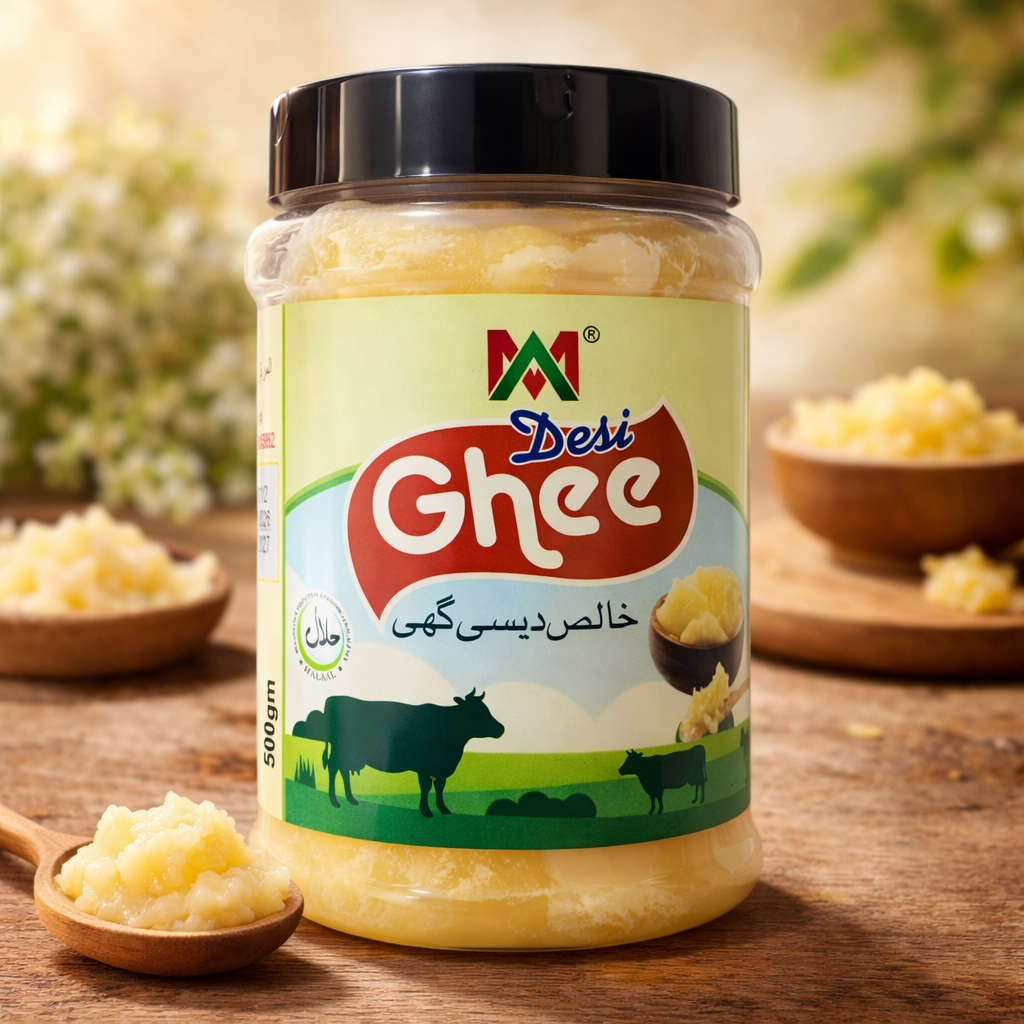
Desi ghee has been a popular ingredient in South Asian kitchens for generations. Known for its rich aroma, distinctive taste, and versatility, it is commonly used in cooking, baking, traditional recipes, and desserts. However, with so many products available in the market, customers often wonder how they can identify pure desi ghee before making a purchase.
Not every product labeled “ghee” will necessarily have the same ingredients, quality, or production process. Some products may be blended with other fats or oils, while others may use different manufacturing methods. This makes it important to understand what you should look for when buying desi ghee.
In this guide, we will discuss 7 important things you should check before buying desi ghee, including the ingredient list, packaging, aroma, texture, color, manufacturer information, and storage details.
What Is Desi Ghee?
Desi ghee is a clarified form of butter traditionally made by heating butter or cream and separating the milk solids and moisture from the fat.
The traditional process results in a golden-colored fat with a distinctive aroma and rich flavor. Desi ghee is widely used in Pakistani, Indian, and other South Asian cuisines.
It can be used for cooking, frying, baking, preparing traditional sweets, and adding flavor to various dishes.
The quality of ghee can depend on factors such as the source of milk, production method, handling, storage, and packaging.
Because different products can vary considerably, consumers should carefully check the product information before purchasing.
What Does Pure Desi Ghee Mean?
The term “pure desi ghee” generally refers to ghee made from milk-derived ingredients without intentionally mixing it with unrelated edible oils or fats.
However, consumers should not rely only on the word “pure” printed on a label.
The most useful approach is to look at the complete product information, including the ingredient list, manufacturer details, packaging, and any relevant quality or food-safety information.
If you are buying packaged desi ghee, the label should provide enough information for you to understand what you are purchasing.
7 Things to Check Before Buying Pure Desi Ghee
1. Check the Ingredient List
The first and most important thing to check is the ingredient list.
A product’s ingredient list can tell you more than its marketing claims. Before buying desi ghee, look carefully at the ingredients printed on the packaging.
Traditional ghee is made from milk-derived ingredients. If the product contains additional vegetable oils, shortening, or other fats, it may not be the type of pure ghee you are looking for.
Do not judge a product solely by its front label. Turn the package around and read the complete ingredient information.
What should you look for?
Check for:
- Clearly listed ingredients
- Milk or milk-derived ingredients where applicable
- No unexpected added oils or fats
- Clear product labeling
- Manufacturer information
If the ingredient list is unclear or missing, consider choosing a product with more transparent labeling.
2. Examine the Color
The color of desi ghee can provide a useful visual clue, but it should not be used as the only test of purity.
Depending on factors such as the milk source, animal diet, processing method, and storage conditions, ghee can range from pale yellow to a deeper golden shade.
Some ghee may appear almost white or cream-colored, while other varieties can have a noticeably yellow or golden appearance.
Therefore, there is no single color that proves a product is pure.
Why can the color vary?
The natural color of ghee can be affected by:
- Source of milk
- Seasonal variations
- Animal feed
- Production method
- Temperature
- Storage conditions
For this reason, be cautious of claims such as “only this exact color means pure ghee.”
Color can help you evaluate the product visually, but it should be considered together with the ingredient list, labeling, smell, texture, and other information.
3. Pay Attention to the Aroma
Good-quality ghee typically has a noticeable buttery, rich, and characteristic aroma.
When you open a fresh container, the smell should be pleasant and consistent with a milk-derived fat.
A strong, unusual, chemical-like, rancid, or unpleasant smell may indicate that the product is old, improperly stored, or of questionable quality.
However, aroma alone cannot scientifically confirm purity.
What should quality ghee smell like?
Depending on the type and production method, you may notice:
- A buttery aroma
- A mild dairy smell
- A rich, cooked-butter fragrance
- A pleasant nutty note
The exact aroma can vary between products.
If the smell seems significantly different from what you expect, check the expiry or best-before date and storage conditions before consuming the product.
4. Check the Texture and Consistency
Another characteristic you can observe is the texture of the ghee.
Ghee can be liquid, semi-solid, or solid depending on temperature. It may become firm in cooler conditions and more fluid in warmer environments.
Therefore, you should not automatically assume that solid ghee is pure or that liquid ghee is fake.
Temperature has a major effect on ghee’s consistency.
What should you look for?
A good-quality product should generally have a consistent appearance appropriate for its storage temperature.
Look for:
- Consistent texture
- No unexpected separation
- No foreign particles
- No signs of contamination
- Properly sealed packaging
Remember that natural changes in texture can occur as temperature changes.
For example, ghee may become softer during hot weather and firmer during colder weather. This is normal and does not necessarily indicate a problem.
5. Check the Packaging and Seal
Packaging is another important factor that customers sometimes overlook.
Before purchasing ghee, carefully inspect the container.
Make sure:
- The package is properly sealed.
- There is no leakage.
- The lid is not damaged.
- The container is clean.
- The label is readable.
- There are no signs of tampering.
- The product has been stored appropriately.
A damaged or poorly sealed container can expose the product to air, moisture, contaminants, or other environmental factors.
If you are purchasing ghee online, look for a seller that provides clear product information and uses appropriate packaging for delivery.
For ecommerce purchases, you can also check product reviews from verified customers where available.
6. Check the Manufacturer and Product Information
A trustworthy food product should provide clear information about the company or manufacturer responsible for producing and packaging it.
Before buying desi ghee, look for details such as:
- Brand name
- Manufacturer or packer name
- Contact information
- Batch or lot number
- Manufacturing date
- Best-before or expiry information
- Net weight
- Storage instructions
- Relevant food labeling information
Transparent product information can make it easier for consumers to understand where the product comes from and how it should be handled.
If a product makes impressive claims but provides very little information about its manufacturer or ingredients, consider looking for an alternative.
7. Check the Price and Avoid Unusually Cheap Products
Price can also provide context when evaluating desi ghee.
Pure, quality ingredients and proper processing, packaging, and storage all contribute to the cost of a food product.
If a product is being sold at an unusually low price compared with similar products, you may want to investigate further.
However, price alone cannot prove whether ghee is pure.
An expensive product is not automatically pure, and a cheaper product is not automatically adulterated.
Instead, compare:
- Ingredients
- Net weight
- Brand reputation
- Manufacturing information
- Packaging
- Product reviews
- Quality certifications where applicable
- Storage and delivery conditions
Making a decision based on several factors is more reliable than using price alone.
Can You Test Desi Ghee at Home?
You may find various traditional “home tests” online that claim to identify pure ghee. These can include freezing, heating, water tests, color observations, or other methods.
However, it is important to understand that simple home tests cannot reliably prove the purity or authenticity of a food product.
For example, the way ghee behaves when heated or cooled can vary naturally depending on its composition and temperature.
Similarly, color and texture can differ between genuine products.
If you have serious concerns about adulteration or product authenticity, laboratory testing through an appropriate food-testing facility is much more reliable than relying on viral social-media tests.
Why Product Labels Matter
Food labels are one of the most useful sources of information available to consumers.
Before purchasing packaged desi ghee, take a moment to read the label rather than relying entirely on advertisements or product photos.
A good product label should make it easy to understand:
- What the product contains
- How much product is in the package
- Who produced or packed it
- How to store it
- When it should ideally be consumed
- Any relevant warnings or allergen information
Clear labeling helps customers make informed purchasing decisions.
How to Store Desi Ghee Properly
Once you purchase good-quality ghee, proper storage is important for maintaining its quality.
Follow the storage instructions provided by the manufacturer.
General storage practices may include:
Keep the Container Closed
Always close the container tightly after use.
This helps reduce exposure to air, moisture, dust, and other contaminants.
Use a Clean and Dry Spoon
Avoid introducing water or food particles into the container.
Always use a clean, dry spoon when taking out ghee.
Store Away From Excessive Heat
Keep the container away from direct sunlight and excessive heat unless the product’s packaging specifically recommends otherwise.
Follow the Manufacturer’s Instructions
Different products may have different storage requirements, so always prioritize the instructions printed on the packaging.
Pure Desi Ghee vs. Other Cooking Fats
Desi ghee is one of several fats used in South Asian cooking.
Other options include:
- Butter
- Vegetable oils
- Coconut oil
- Olive oil
- Shortening
- Other specialty cooking fats
Each has different properties, flavors, and culinary uses.
When choosing a cooking fat, consider your recipe, dietary requirements, taste preferences, and the product’s ingredients.
There is no need to assume that one cooking fat is universally suitable for everyone or every recipe.
How to Buy Desi Ghee Online
Online shopping has made it easier to purchase natural and traditional food products from home. However, you should be just as careful when buying ghee online as you would be in a physical store.
Before placing an order, check:
Product Description
Read the complete product description instead of relying only on the product title.
Ingredients
Look for a clearly stated ingredient list.
Product Size
Check whether the package contains 250g, 500g, 1kg, or another quantity.
Packaging
Look for information about how the product is packaged for delivery.
Reviews
Read genuine customer reviews when available.
Delivery
Check whether the seller delivers to your location and how the product will be handled during shipping.
Seller Information
Make sure you can identify the business selling the product and find a way to contact them if you have questions.
Frequently Asked Questions About Pure Desi Ghee
How can I identify pure desi ghee?
Start by checking the ingredient list, product labeling, manufacturer information, packaging, aroma, texture, and storage details. No single visual or home test can reliably prove purity.
What color should pure desi ghee be?
Desi ghee can vary in color from pale or creamy to yellow or golden. Color can depend on several natural factors, so it should not be used as the only indicator of purity.
Does pure ghee become solid?
Ghee can become firm or semi-solid at cooler temperatures and more liquid at warmer temperatures. Its consistency is affected by temperature and does not by itself prove purity.
Does pure desi ghee have a smell?
Ghee generally has a characteristic buttery or dairy aroma. The exact smell can vary depending on the ingredients and production process.
Can I check ghee purity with a home test?
Many home tests are promoted online, but they cannot reliably confirm whether a food product is pure. Laboratory analysis is a more dependable approach when authenticity is a serious concern.
How should desi ghee be stored?
Follow the storage instructions provided on the packaging. In general, keep the container tightly closed, use a clean and dry spoon, and protect it from excessive heat, moisture, and contamination.
Is expensive desi ghee always pure?
No. Price alone does not prove purity. Always consider the ingredients, labeling, manufacturer information, packaging, and other quality indicators.
Final Thoughts
Buying pure desi ghee does not have to be confusing. Instead of relying on one viral home test or a single visual characteristic, look at the complete picture.
Before purchasing, check the ingredients, examine the packaging, consider the aroma and texture, review the manufacturer information, check the date and storage instructions, and compare the product with other reputable options.
Remember that the color, smell, consistency, or price of ghee alone cannot scientifically prove its purity. Clear labeling and transparent product information are much more useful when making a purchasing decision.
If you are looking for quality desi ghee for your kitchen, take time to understand the product you are buying and choose a seller that provides clear information about its ingredients, packaging, and storage.
For customers looking for convenient online shopping, you can explore our [Desi Ghee collection] and select the size and product option that suits your needs.