
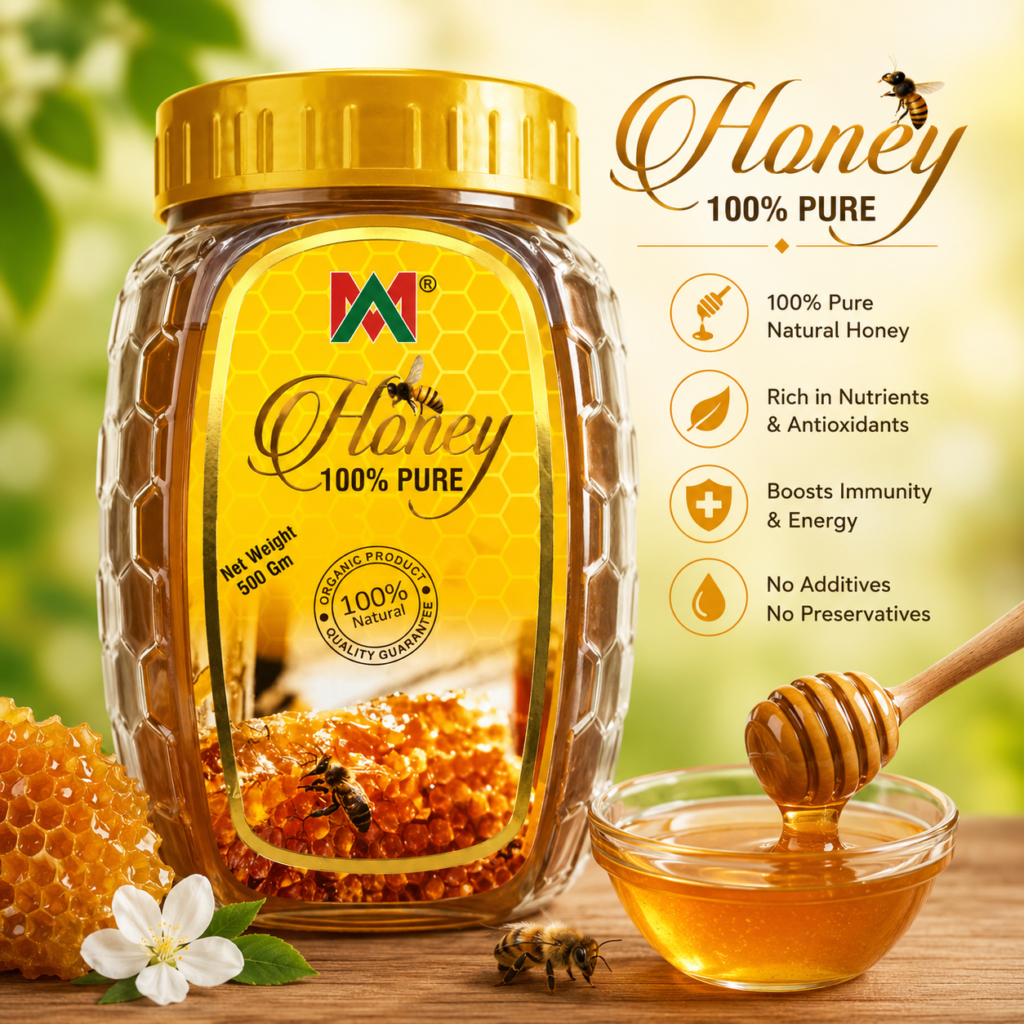
Honey is one of the most popular natural sweeteners in the world. It has been used for centuries in cooking, beverages, desserts, and traditional food practices. Today, customers can find many different types of honey in supermarkets and online stores, including wildflower honey, acacia honey, sidr honey, and other varieties.
With so many products available, one common question is: How can you identify pure honey?
Many people search online for simple home tests to determine whether honey is pure or adulterated. However, the reality is that color, thickness, crystallization, or a simple kitchen test cannot reliably confirm the complete composition or authenticity of honey.
The best way to make an informed purchase is to understand the product label, ingredients, source, processing information, packaging, storage conditions, and seller reputation.
In this complete guide, we will explain what pure honey means, what to check before buying honey, why honey crystallizes, how color and texture vary, and how to choose natural honey with confidence.
What Is Pure Honey?
Pure honey is honey that consists primarily of honey produced by bees, without intentional dilution or the addition of unrelated sweeteners such as sugar syrups.
Honey is naturally produced by bees from floral nectar or, in some cases, other plant-derived sources. The exact characteristics of honey can vary depending on the flowers visited by bees, geographical location, season, harvesting practices, and processing methods.
Because honey is a natural product, two genuine varieties may look and taste quite different.
For example, one honey may be light golden and relatively mild, while another may be darker with a stronger aroma and flavor.
Therefore, there is no single color, smell, or consistency that proves a honey product is pure.
What Is Natural Honey?
Natural honey generally refers to honey produced by bees and harvested from beehives, with minimal processing depending on the product.
The term “natural” can be used differently by different sellers, so consumers should always check the product label and description rather than relying solely on marketing language.
When purchasing packaged honey, look for clear information about:
- Product ingredients
- Honey variety
- Source or origin
- Net weight
- Producer or brand
- Packaging
- Storage instructions
- Best-before information
Transparent product information makes it easier to understand what you are purchasing.
7 Things to Check Before Buying Pure Honey
1. Check the Ingredient List
The first thing you should check when buying packaged honey is the ingredient list.
If a product is marketed as pure honey, the ingredient information should clearly tell you what the product contains.
Be cautious when the product contains additional sweeteners or syrups that you were not expecting.
Some products may be marketed as honey blends or honey-based products rather than pure honey. These are different from a product consisting solely of honey.
Always read the back of the package rather than relying only on the product name printed on the front.
What should you look for?
Check for:
- A clearly stated ingredient list
- The type or variety of honey
- Manufacturer or producer information
- Net weight
- Relevant food labeling information
- Storage instructions
If the information is unclear, consider choosing a product with more transparent labeling.
2. Consider the Source and Origin
The source of honey can tell you a lot about the product.
Honey can be produced from nectar collected from many different plants. Some varieties are associated with specific floral sources, while others are blended from multiple sources.
You may see honey described as:
- Wildflower honey
- Sidr honey
- Acacia honey
- Clover honey
- Eucalyptus honey
- Multifloral honey
The flavor, color, aroma, and texture can vary considerably between these varieties.
If a seller provides information about the geographical or floral source of the honey, read it carefully.
For example, if a product is marketed as a particular floral variety, the product description should provide reasonable information explaining the variety and origin.
Source information does not automatically prove purity, but it can help you make a more informed decision.
3. Look at the Color — But Don’t Use It as the Only Test
Honey can range from almost transparent or pale golden to amber, reddish-brown, or very dark brown.
This variation is completely normal.
The color of honey can be influenced by:
- Floral source
- Plant species
- Geographic location
- Harvesting season
- Storage
- Processing
Because of this, it is not accurate to say that “light honey is pure” or “dark honey is pure.”
Similarly, an unusually attractive golden color does not automatically indicate superior quality.
Color should be considered alongside other characteristics such as the source, ingredient information, aroma, flavor, and labeling.
4. Pay Attention to the Aroma and Flavor
Pure honey has a characteristic aroma and flavor, but these can differ substantially depending on the floral source.
Some honey varieties have a mild, delicate flavor, while others have a stronger floral, earthy, fruity, or caramel-like profile.
When honey smells fresh and pleasant, it can be a positive sensory characteristic.
On the other hand, a sour, fermented, chemical-like, or otherwise unusual smell may indicate that the product has been improperly stored or has undergone unwanted changes.
However, smell and taste alone cannot scientifically confirm that honey is pure.
Why does honey taste different?
The flavor can depend on:
- Flowers visited by bees
- Geographic region
- Climate
- Harvesting period
- Processing
- Storage conditions
This is why two genuine honey products can taste completely different.
5. Understand Honey Crystallization
One of the biggest misconceptions about honey is that crystallized honey must be fake.
This is not true.
Natural honey can crystallize.
Crystallization occurs when glucose naturally separates from the water in honey and forms crystals.
Some types of honey crystallize quickly, while others remain liquid for much longer.
The speed and texture of crystallization can depend on:
- Floral source
- Glucose-to-fructose ratio
- Temperature
- Water content
- Storage conditions
- Presence of natural particles such as pollen
Crystallized honey can become grainy, creamy, or semi-solid.
Therefore, if your honey becomes cloudy or develops crystals over time, this does not automatically mean it has gone bad or is adulterated.
6. Check the Packaging
Packaging plays an important role in protecting honey during storage and transportation.
Before purchasing honey, inspect the container carefully.
Look for:
- Properly sealed packaging
- No leakage
- No visible contamination
- Clear labeling
- Intact lid or seal
- Appropriate container size
- Product information that is easy to read
If you are buying honey online, check whether the seller explains how the product is packaged for shipping.
Honey containers should be protected from damage during transportation.
A damaged or leaking container can expose the product to contaminants and make it unsuitable for consumption.
7. Check the Seller or Brand Information
The reputation and transparency of the seller can also help you make a better purchasing decision.
A reliable seller should provide clear information about the product instead of making vague claims.
Look for:
- Brand name
- Producer or manufacturer
- Contact information
- Product description
- Ingredients
- Net weight
- Source/origin information where applicable
- Storage instructions
- Best-before information
- Customer reviews where available
If a seller makes dramatic claims such as “100% guaranteed medicinal honey” without providing meaningful product information, approach the claim carefully.
A trustworthy food business should focus on transparent product information rather than exaggerated promises.
Common Home Tests for Honey: Do They Really Work?
You may have seen several viral methods for testing honey at home.
These can include:
- Water test
- Flame test
- Thumb test
- Bread test
- Tissue or paper test
- Finger test
- Refrigeration test
These methods are often presented as quick ways to determine whether honey is pure.
However, they should not be considered reliable scientific methods for confirming honey purity or detecting all forms of adulteration.
For example, the way honey behaves in water can be affected by its moisture content and temperature. Similarly, thickness and crystallization can vary naturally among different honey varieties.
A home test may show you a physical characteristic, but it cannot provide a complete analysis of the product’s composition.
If authenticity or adulteration is a serious concern, appropriate laboratory testing is much more reliable.
Does Pure Honey Crystallize?
Yes, pure honey can crystallize.
Crystallization is a natural process and does not necessarily mean that honey is fake, spoiled, or low quality.
Some honey varieties crystallize within a relatively short period, while others can remain liquid for months or longer.
The texture can also vary. Crystallized honey may become:
- Grainy
- Creamy
- Thick
- Semi-solid
If you prefer liquid honey, crystallized honey can generally be gently warmed to return it to a more fluid consistency.
However, avoid excessive heating because high temperatures can affect the characteristics of honey.
Why Does Honey Become Darker?
Honey can naturally vary in color, and some honey may become darker over time depending on storage conditions and other factors.
Floral source is one of the biggest reasons for natural color differences.
For example, some floral varieties naturally produce light-colored honey, while others produce darker honey.
Therefore, a darker color does not automatically mean that honey is old or fake.
If you notice major changes in color, smell, or appearance, check the product’s storage conditions and best-before information.
How to Store Honey Properly
Proper storage can help maintain honey’s quality.
Keep Honey in a Tightly Closed Container
Always close the lid properly after use.
This helps prevent moisture, dust, and other contaminants from entering the container.
Keep It in a Dry Place
Store honey in a clean, dry location.
Avoid unnecessary exposure to moisture.
Avoid Excessive Heat
Keep honey away from direct sunlight and excessive heat.
High temperatures can affect some of the natural characteristics of honey.
Use a Clean Spoon
Always use a clean, dry spoon when taking honey from the container.
Introducing water or food particles into the jar can affect its quality.
How to Buy Pure Honey Online
Buying honey online can be convenient, but you should carefully review the product information before placing an order.
1. Read the Complete Product Description
Don’t rely only on the product title.
Read the description to understand:
- Honey variety
- Weight
- Source
- Packaging
- Storage instructions
2. Check the Ingredients
Look for clear ingredient information.
3. Check the Product Size
Make sure you know whether you are buying:
- 250g
- 500g
- 750g
- 1kg
- Or another size
4. Review Customer Feedback
If reviews are available, read them to understand other customers’ experiences with the product and seller.
5. Check Delivery Information
Make sure the seller provides delivery details for your location.
6. Check the Seller’s Contact Information
A professional seller should provide a way for customers to contact the business.
Is Expensive Honey Always Pure?
Not necessarily.
Price alone cannot determine whether honey is pure.
Different honey varieties can have different prices because of factors such as:
- Floral source
- Availability
- Geographic origin
- Harvesting method
- Packaging
- Production scale
- Brand positioning
A very expensive product is not automatically pure, just as a lower-priced product is not automatically adulterated.
Instead of judging honey by price alone, consider the complete product information.
Frequently Asked Questions About Pure Honey
How can I identify pure honey?
There is no single visual home test that can reliably prove honey purity. Start by checking the ingredient list, source, labeling, packaging, seller information, and storage details. Laboratory analysis is more reliable when authenticity needs to be confirmed.
Does pure honey crystallize?
Yes. Genuine honey can naturally crystallize. The speed and texture of crystallization vary depending on the honey’s floral source and composition.
What color is pure honey?
Pure honey can be light, golden, amber, reddish, or dark brown depending on its floral source and other natural factors. Color alone cannot confirm purity.
Should pure honey be thick?
Honey naturally has a viscous texture, but thickness can vary depending on temperature, moisture content, floral source, and storage conditions. Thickness alone is not a reliable purity test.
Can pure honey become cloudy?
Yes. Honey can become cloudy or develop crystals naturally as it crystallizes. This does not automatically mean the honey is fake.
Can I test honey at home?
Various home tests are popular online, but they cannot reliably determine the complete purity or composition of honey. Laboratory analysis is more dependable.
How should honey be stored?
Keep honey in a tightly closed container in a clean, dry place away from excessive heat and direct sunlight. Always follow the storage instructions on the product packaging.
Final Thoughts
Identifying pure honey is not as simple as performing one viral kitchen test or checking whether the honey has a particular color or thickness.
Honey is a natural product, and its appearance, flavor, aroma, and texture can vary significantly depending on its floral source, geographical origin, harvesting season, processing, and storage conditions.
The best approach is to look at the complete picture.
Before buying honey, check the ingredients, source, product labeling, packaging, seller information, storage instructions, and customer feedback. Be cautious about exaggerated claims and remember that no single home test can reliably confirm purity.
If you are purchasing honey online, choose a seller that provides clear and transparent information about the product.
Whether you prefer wildflower honey, sidr honey, or another variety, understanding how honey naturally varies can help you make a more informed purchasing decision.
Explore our [Natural Honey collection] to discover our range of honey products and choose an option suitable for your home.